
It seems like every week there’s another revolutionary treatment that surfs the waves of the World Wide Web to reach your Facebook feed. Some promise game-changing instant results, while others propose a permanent placement in your daily routine. By the same time next week, many of these fads fade into the endless sea of suggestions leaving you wondering how best to support your ongoing wellness journey.
Following the science may be the best place to start. Light therapy, properly known as photobiomodulation (PBM), may have started as an accidental discovery by NASA in the 90s during research on plant growth in space, but it has led to positive results in many areas of wellness. Over the years, studies have strengthened the evidence on how red and near-infrared LED light exposure supports physical and mental health. While red light can improve skin surface, near-infrared light penetrates deeper, giving the combined use of both even more significant impact.
Red and near-infrared lights work to stimulate the mitochondria,1 which power cell function and provide energy to the body. Exposure to light therapy has been shown in studies to positively impact cognitive function, skin and hair, inflammation and sleep patterns.2,3 While research continues, this therapy is becoming more accessible, allowing more people to incorporate it into their wellness routine.
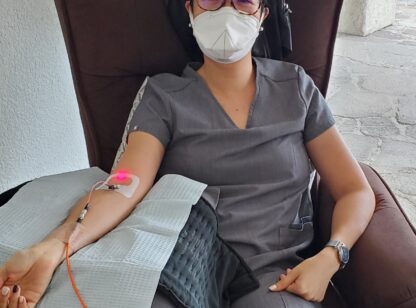
With current technology available, there are several methods for delivering this non-invasive treatment. From canopy panels to transcranial PBM helmets, results are best achieved with consistent, timed exposure. Because many of these options are now available for home use, visiting a business that specializes in this therapy is the best way to begin your journey and learn how to customize it to your needs.
A standard recommendation for light therapy is two sessions per week. A session can last 15 minutes or more depending on the intensity of the red and near-infrared lights, how long you’re exposed to them and how many pieces of equipment are used. In addition to consistency, remaining hydrated is also important.
As exciting and promising as PBM may be, the future only looks (pardon the pun) brighter. Studies are currently underway to explore how red light therapy can transform specific conditions, including eye health. According to the National Library of Medicine, the use of red light “has shown remarkable, multi-faceted effects in ophthalmology: slowing myopia progression, protecting retinal cells in glaucoma, reducing inflammation in AMD, and relieving symptoms of dry eye disease.”4
With many new products on the market, it’s important to verify the science behind what you read and consider trying new approaches to take your wellness into your own hands.
India Braemer and Joseph Scherger, MD, are with Restore Health Disease Reversal in Indian Wells and can be reached at (760) 898.9663.
References: 1) https://www.mdanderson.org/cancerwise/what-is-red-light-therapy.h00-159701490.html; 2) https://pmc.ncbi.nlm.nih.gov/articles/PMC3499892/; 3) https://my.clevelandclinic.org/health/articles/22114-red-light-therapy; 4) https://pubmed.ncbi.nlm.nih.gov/40105942/

















Comments (0)