
Pentadecanoic acid, also known as C15, is a recently recognized saturated fatty acid found primarily in dairy products. Mounting evidence suggests C15 has numerous health benefits that support a return to consuming full-fat dairy.
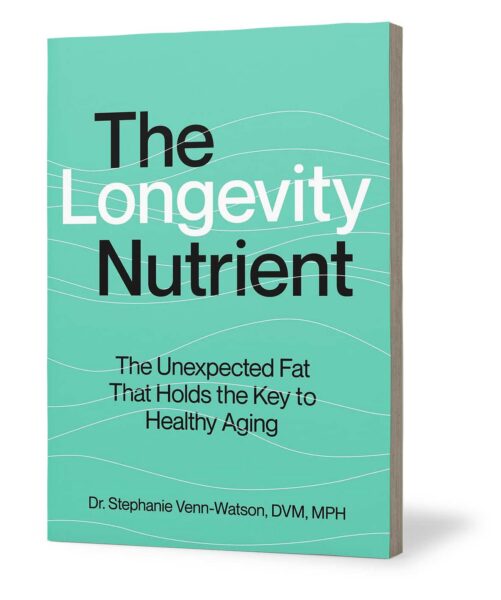
Author Stephanie Venn-Watson, DVM, MPH, is a veterinary epidemiologist who studies Navy dolphins in San Diego. She argues that dolphins develop many of the same chronic health problems as humans, such as metabolic syndrome and fatty liver disease, and therefore are a more appropriate lab animal to study for human health than are mice, worms or fruit flies. Dr. Venn-Watson has teamed with scientists at the University of California, San Diego to study the health and longevity benefits of C15.
She documented her findings and theories in her recent book, The Longevity Nutrient: The Unexpected Fat That Holds the Key to Healthy Aging (2025). The book’s primary strength is that it offers numerous lessons in the biology of fatty acids. Reading it, I felt like I was taking a course in fatty acid biology, and the writing style is clear and engaging. (At times, it’s almost too informal, such as when she calls iron a “bully.”) Venn-Watson narrates the Audible version, and I listened to it twice to more fully absorb the material. The written text is full of useful reference material; the cited literature is more than 50 pages. Much of the research on C15 and other fatty acids is done outside the United States.
A fascinating part of this book that reflects the author’s epidemiology background is its documentation of how Americans’ health declined when marketers began pushing nonfat and low-fat milk in the 1970s.1
Throughout the book, Venn-Watson argues that C15 meets the criteria of an essential fatty acid because it is required in the diet to meet our basic health needs. Linoleic acid and alpha-linolenic acid are the two traditionally recognized essential fatty acids, meaning they must be obtained through the diet. C15 is not currently included among the essential fatty acids recognized in established U.S. dietary guidance, but Venn-Watson builds the case that it should be. She also argues that C15 is a more promising subject for longevity research than candidates such as metformin or rapamycin (two prescription drugs developed for other purposes that may also have longevity benefits).
C15 is an odd-chain fatty acid, and the book points out its anti-inflammatory benefits. C17, also found in dairy fat, is a close second in its benefits. However, dairy fat also includes even-chain fatty acids C16 and C18, which are proinflammatory and contribute to heart disease and other problems. Hence, dairy fat is a double-edged sword.
If you’d like to understand the current biology of fatty acids, I recommend this book. Afterward, you may find yourself pondering a return to full-fat dairy, butter and cheese for its benefits, or you might consider taking a C15 supplement.
On this point, Venn-Watson has a conflict of interest. She and her husband sell the most available C15 supplement, Fatty 15, and it costs about $50 a month. They argue that the only way to get the longevity benefits of C15 is by taking a pure supplement rather than relying upon the mixed bag of saturated fats from full-fat dairy products. With the number of people taking the C15 supplement growing globally, will this result in a new cohort of super-agers, or just financial success for the author? Since most people cannot afford, or may choose not to take, the supplement, a major weakness of this book is that Venn-Watson fails to provide clear dietary recommendations for achieving healthy C15 levels.
Joseph Scherger is the founder of Restore Health Disease Reversal in Indian Wells, a concierge primary care clinic dedicated to reversing chronic conditions through lifestyle medicine. For more information, call (760) 898.9663 or visit www.restorehealth.me.
References: 1) Khan MAB, Hashim MJ, King JK, et al. Epidemiology of Type 2 Diabetes – Global Burden of Disease and Forecasted Trends. Epidemiol Glob Health. 2020;10(1):107-111;


























Comments (0)