
Last month, over 300 people with Parkinson’s and their caregivers gathered in Palm Desert for the second annual Parkinson’s Today Symposium, a collaboration between Parkinson’s Resource Organization (PRO) and The Michael J. Fox Foundation (MJFF).
Parkinson’s Resource Organization (PRO) has served Coachella Valley and Southern California for 35 years, providing free emotional and practical support for people with Parkinson’s and caregivers. In addition to their print and online resources, PRO offers in-person support groups in Palm Desert, Palm Springs, Yucca Valley, and Los Angeles. PRO’s event partner, The Michael J. Fox Foundation (MJFF) is dedicated to finding a cure for Parkinson’s through research.


A primary goal of PRO is to remove barriers to high-quality, expert-led education through thoughtful collaborations with leaders in the Parkinson’s world. This symposium is a force-multiplier for Coachella Valley, which faces a serious shortage in expert Parkinson’s care. It is estimated that 5-10,000 people are living with Parkinson’s in the Coachella Valley, with only one movement disorder specialist to treat them.
The free, half-day event covered topics like advanced Parkinson’s care, building a care team, effective patient-doctor communication, and Parkinson’s research and policy. Panelists included movement disorder specialist John Legge, MD, of Eisenhower Medical Center and Jessica Shields, MD, of Desert Care Network, the valley’s only neurosurgeon specializing in surgical Parkinson’s interventions.
Together, they walked attendees through options and priorities for advanced Parkinson’s care. Dr. Shields detailed the complex technical process of deep brain stimulation, a surgical procedure that implants a pacemaker-like device to deliver electrical impulses to the brain and treat the movement disorder.
Dr. Legge underscored the importance of a holistic approach to Parkinson’s. “Keeping Parkinson’s in the back seat is the goal,” he said. “So, it’s about quality of life, diet and exercise, taking your medications, staying involved in the community and staying active.
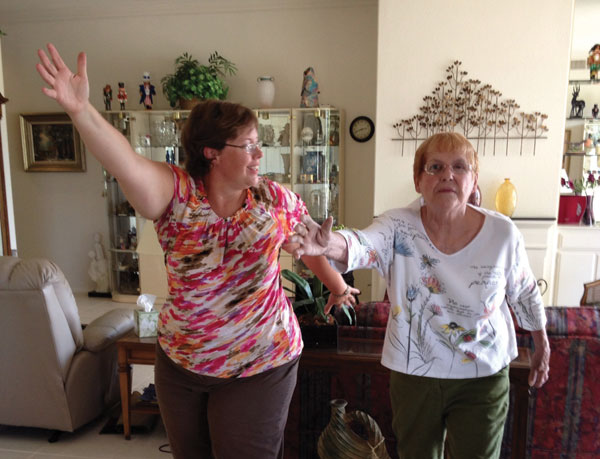
Attendees also heard from people living with Parkinson’s. Steph and Madge DeSales shared their experience navigating the diagnosis and juggling treatments. “I go out and do my walking and scream to the world that I didn’t sign up for all of this,” said Madge, “but it’s okay.”
The day concluded with an overview of Parkinson’s research and policy from MJFF representatives. “Genetics provides us with an incredible tool for how we can apply biological research to ask questions,” said Bradford Casey, PhD, who guides aspects of MJFF’s research, including coordination with the Global Parkinson’s Genetics Program. “It allows us to start understanding how different systems work together in our body; how they may go wrong in disease.”


Casey explained that genetics currently accounts for 15% of Parkinson’s cases, a number that may increase as researchers learn more about the genetic profiles of Parkinson’s patients. Aside from causing Parkinson’s, genetics could yield information about how certain treatments work within the Parkinson’s brain, ultimately leading researchers towards effective therapies.
The 2026 Parkinson’s Today Symposium event was recorded and will be made available at no cost on PRO’s website and on PRO’s YouTube channel @ParkinsonsResourceOrg.
Eileen Lynch is the executive director of Parkinson’s Resource Organization. For more information, visit www.parkinsonsresource.org.


















Comments (2)
Recently I joined The Parkinson’s Resource Organization as a Volunteer and support group facilitator This group provides support services to patients and their Care Partners throughout the Valley As an RN diagnosed with Prodromal Parkinson’s Disease and member of The Michael J Fox Foundation Community Advisory Board I bring a unique perspective to the organization I encourage everyone to get involved by knowing the early symptoms of Parkinson’s Disease such as loss of smell constipation, low blood pressure urinary problems, memory or thinking problems and excessive day time sleepiness to name a few that may present themselves for years before the typical motor symptoms most people associate with Parkinson’s Disease experience like Resting Tremors, Bradykinesia, Rigidity and Postural Instability
Thank you, Art! We agree. PRO is an excellent resource for our community. You will hear more from them in our upcoming Nov Dec edition as they work to spread awareness of all you mention above. Thank you for reading Desert Health!