
If insults that degrade the brain are replaced by healthy nutrition and lifestyle, is the brain capable of healing, similar to other organs? Contrary to conventional thinking in neurology, Dale Bredesen, MD, gives a resounding “yes.”
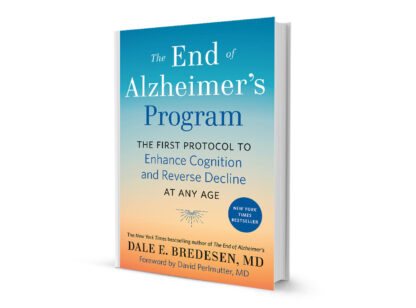
Dr. Bredesen, a research neurologist, has a series of cases dating back to 2014 when he published his first report of remission of early Alzheimer’s disease. Two years later, he published a report of 11 patients, and subsequently, through his work and his New York Times best-selling book, The End of Alzheimer’s, hundreds of patients have been helped on his protocol.
Bredesen is best described as a neurobiologist. Like his mentor, Leroy Hood, MD, PhD, he studied biology at California Institute of Technology before graduating from Duke University Medical School. For over 20 years, he searched for a “magic bullet” to treat Alzheimer’s disease and found that all drugs that could reduce the pathological markers of Alzheimer’s, amyloid plaques and tau protein bundles, actually resulted in patients getting worse. Bredesen realized these markers are actually scar tissue on the chronic inflammation causing the disease, and you cannot treat a disease by treating the scars.
Bredesen’s wife is an integrative primary care physician and advised him that to prevent and treat this disease, you have to fix the patients’ lifestyle. They compared the disease to a leaking roof with 36 different holes which all must be patched. From that perspective, Bredesen developed and refined a protocol he named ReCODE (reversing cognitive decline) that is being used worldwide.
Bredesen is a controversial figure in the academic neurology community. A weakness in his research is that he publishes patient success stories and is unclear about who succeeds and who fails. The Ageless Brain is the best and most useful of his four books on preventing and reversing cognitive decline.
Early-stage Alzheimer’s can now be tested through blood biomarkers for the accumulation of amyloid and tau proteins. Since I have one genetic marker for the disease, an ApoE4 chromosome, I had this test done and am gratified that at age 74,
I do not have these markers. I follow the Bredesen recommended lifestyle.
As described in his book, Bredesen notes that the most critical actions for an “ageless brain” are to:
- Maintain normal blood sugar levels.
- Avoid high glycemic foods (those containing sugar) and inflammatory foods like grains.
- Practice intermittent fasting of 12 hours or more daily.
- Maintain low inflammatory markers such as a C-reactive protein (CRP) less than one.
- Avoid toxins such as lead, mercury and arsenic.
These levels can be checked in standard blood tests; avoiding mercury-containing fish such as tuna and swordfish will lower your mercury levels within three months.
Bredesen calls this dietary approach KetoFlex 12/3. It is a ketogenic Mediterranean diet low in carbohydrates, with 12 hours of fasting, including no food three hours before sleep. Other dietary recommendations are foods high in phytonutrients (such as polyphenols), fiber, and monounsaturated and omega-3 fats (avocados, nuts and seeds). He recommends wild-caught low mercury fish (salmon, anchovies, sardines, herring), only pasture-raised organic chicken and eggs and grass-fed beef. The diet is also rich in cruciferous and leafy green vegetables with no grains, dairy or
simple carbohydrates.
Having an ageless brain also requires regular physical activity with movement and strength activities daily, restful, unmedicated sleep for 7-8 hours nightly, stress management and a rich social life with meaning and purpose.
In today’s modern culture, following this lifestyle consistently is not easy, but the rewards of having a healthy brain and body are certainly worth it. Reading The Ageless Brain is a good place to start.
Dr. Scherger is the founder of Restore Health Disease Reversal in Indian Wells, a clinic dedicated to weight loss and reversing chronic medical conditions. To schedule a consultation, call (760) 898.9663 or visit www.restorehealth.me.


















Comments (0)